
Why Solgar Isn't Enough: The Case for a Mineral-First Foundation
![[HERO] Why Solgar Isn't Enough: The Case for a Mineral-First Foundation](https://cdn.marblism.com/K9PrOsyjDmo.webp)
Let's be honest: if you've been in the supplement game for a while, you've probably had a Solgar bottle on your shelf at some point. Maybe you still do. The dark amber glass, the "Since 1947" badge, the reputation for quality control. Solgar has earned its place as a trusted name in the industry.
But here's the question that matters: Is trust in a brand the same thing as getting what your body actually needs?
After years of working with clients through Stephen Capital Partners and diving deep into nutritional science at First Principles Health, I've come to a challenging conclusion: Even premium brands like Solgar are working from an outdated playbook. They're solving yesterday's problems with yesterday's solutions.
What Solgar Gets Right (And Why It's Not Enough)

Credit where it's due: Solgar isn't your gas station multivitamin. They use chelated minerals for better absorption. They avoid unnecessary fillers. Their manufacturing standards are solid. If you're comparing Solgar to the average drugstore supplement, Solgar wins every time.
But that's a low bar.
The fundamental issue isn't quality control or manufacturing standards. It's the entire philosophy behind isolated, synthetic nutrients. Solgar, like most traditional supplement companies, operates on the assumption that you can extract individual vitamins and minerals, put them in a pill, and replicate what nature provides.
You can't.
Your body doesn't recognize isolated ascorbic acid the same way it recognizes vitamin C in an orange. It doesn't process synthetic B12 the same way it processes B12 from organ meats. And it certainly doesn't know what to do with a pill containing 12 isolated minerals when it evolved to extract 90+ trace minerals from whole foods.
The Synthetic Nutrient Problem
Here's what the supplement industry doesn't advertise: bioavailability isn't just about chelation or capsule design. It's about cofactors, synergists, and the countless compounds that exist in whole-food sources but get lost in isolation.
When you take a Solgar magnesium supplement, you're getting magnesium: maybe magnesium glycinate or magnesium citrate. Both are better absorbed than magnesium oxide, sure. But you're missing the 50+ other trace minerals that work synergistically with magnesium in nature. You're missing the fulvic acid that enhances mineral transport. You're missing the phytonutrients that support mineral utilization at the cellular level.
Traditional supplements give you the main actors but cut out the entire supporting cast. And without that supporting cast, the main actors can't perform their roles effectively.
This is why people take handfuls of pills and still feel deficient. They're addressing individual nutrients without building a proper foundation.
The Mineral-First Philosophy
Most people approach supplementation backward. They start with multivitamins, add some omega-3s, maybe throw in some vitamin D. Minerals come last: if they come at all.
This is like building a house and treating the foundation as an afterthought.
Minerals are cofactors for virtually every enzymatic process in your body. They regulate nerve function, muscle contraction, hormone production, and cellular energy. Vitamins can't do their jobs without adequate mineral status. Proteins can't be properly synthesized. Antioxidant systems can't function.
A mineral-first approach means starting with a comprehensive mineral foundation before layering in targeted vitamins or specialized nutrients. It means prioritizing whole-food, bioavailable mineral sources that provide the full spectrum your body evolved to use.
This is where products like the Mineral Vitality: Sea Moss + Shilajit starter bundle change the game entirely.
Why Sea Moss and Shilajit Are Different
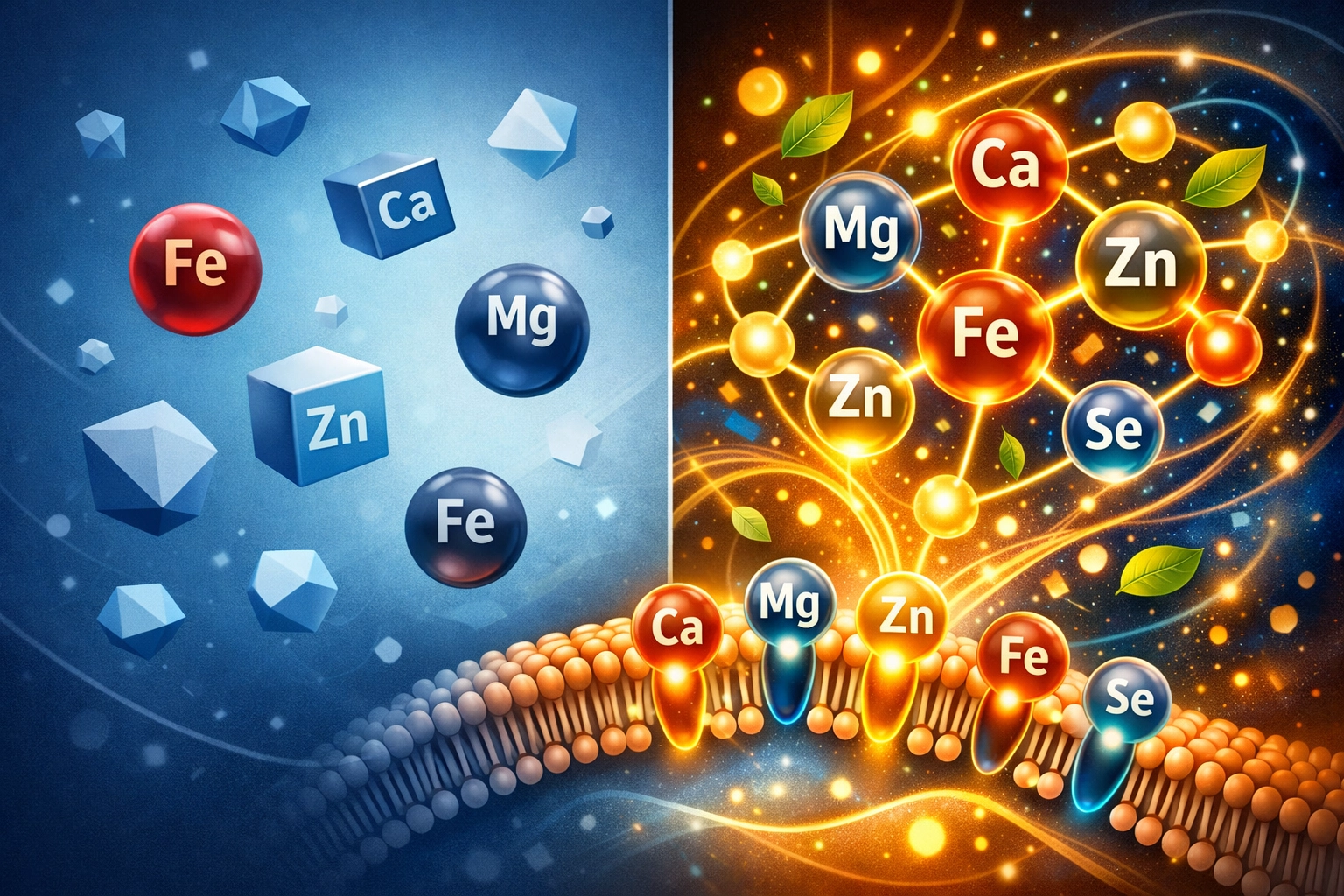
Sea Moss isn't a multivitamin. It's whole food. It contains 92 of the 102 minerals your body needs: in their natural, organic form, bound to the proteins and polysaccharides that facilitate absorption.
When you consume Sea Moss, you're not getting isolated minerals. You're getting a complex matrix that includes:
- Iodine (critical for thyroid function)
- Selenium (supports antioxidant systems)
- Zinc (immune function and hormone production)
- Magnesium (over 300 enzymatic processes)
- Calcium (bone health and cellular signaling)
- Iron (oxygen transport and energy)
But more importantly, you're getting dozens of trace minerals that don't appear on most supplement labels: molybdenum, manganese, copper, chromium, vanadium: minerals that exist in minute quantities but play crucial roles in metabolic function.
Shilajit takes this further. It's not just a mineral source; it's a delivery system. The fulvic acid in Shilajit acts as a chelating agent that enhances mineral bioavailability across the board. It helps transport nutrients into cells and supports mitochondrial function at the most fundamental level.
You cannot replicate this with a pill containing 12 isolated minerals, no matter how well-chelated they are.
The Bioavailability Advantage

Here's a simple test: Go read the label on your Solgar multivitamin. Look at the percentages. Many will be 100% DV, some will be 200%, maybe even 2000% for certain B vitamins.
High percentages don't mean high absorption. In many cases, they mean poor bioavailability compensated with megadoses.
When you take 1000% of your B12 requirement in synthetic cyanocobalamin form, your body might absorb 2-3% of it. The rest is expensive urine.
Whole-food mineral sources work differently. The absorption rates are lower on paper: maybe 30-40%: but the utilization is dramatically higher because you're providing nutrients in forms your body recognizes, complete with cofactors that enhance absorption and utilization.
This is why people often report feeling a difference within days of starting the Mineral Vitality: Sea Moss + Shilajit starter bundle: not because it contains megadoses, but because it provides bioavailable nutrition your body can actually use.
The Practical Comparison
Let's get specific. Here's what a typical Solgar supplement regimen looks like for someone serious about their health:
- Solgar VM-75 Multivitamin: $30-40/month
- Solgar Chelated Magnesium: $15-20/month
- Solgar Selenium: $10-15/month
- Solgar Zinc: $10-15/month
- Additional targeted supplements: $50-100/month
Total: $115-190/month for isolated, synthetic nutrients with partial mineral coverage.
Now consider a mineral-first approach:
Start with the Mineral Vitality: Sea Moss + Shilajit starter bundle. You're getting 90+ organic trace minerals in bioavailable form, fulvic acid for enhanced absorption, and a comprehensive foundation that supports every system in your body.
From there, you add targeted supplements based on actual deficiencies or specific goals: not because you're trying to cover basics.
The cost is lower. The complexity is lower. And the results are better because you've built a proper foundation.
Your Issues. My Priority.
I'm not here to trash Solgar. They make quality products within the paradigm they operate in. But that paradigm is limited.
The supplement industry has trained us to think in terms of isolated nutrients, megadoses, and synthetic forms. We've been taught to chase symptoms with pills instead of building foundations with nutrition.
It's time to think differently.
A mineral-first foundation isn't just about better supplements. It's about working with your biology instead of against it. It's about providing your body with the raw materials it needs in forms it evolved to use.
That's the First Principles Health approach, and it's backed by both cutting-edge nutritional science: because your health is too important for outdated solutions.
If you've been taking supplements for years and still don't feel the way you should, the problem might not be the brand. It might be the entire approach.
Start with minerals. Start with whole foods. Start with what works.
Kevin D. Williams
First Principles Health, a Division of Stephen Capital Partners, LLC